❝ Nico

A cockpit for each of your businesses.

One for each thing you run. Its own Chrome, already signed in. Its own folder. Its own small tools, still running. Nico sits in the other seat — it writes down what you say, reads the page in front of you, and puts the file where it belongs.

All of it on your Mac, under the Claude Code, Codex or Ollama you already have. We never touch a token, and there is nothing to sign into.

Start the 7-day trial Apple silicon · Free for 7 days, then $25/month · no card to start

The gap

A coding agent that only ever writes code is a coding agent you are underusing.

The hard part was never asking for the tool. Claude Code will write a receipt parser in ninety seconds. The hard part is everything after: somewhere for it to live, somewhere for its output to accumulate, a way to run it again next month without rebuilding it.

So the parser gets written, run once in a terminal, and lost.

The subscription isn’t worth it to me just to run a few prompts in Claude Code once a week.Hacker News

I get like $400 worth of tokens from my $20 Claude Code Pro subscription every month.Hacker News

Both of these people are right. The difference between them isn’t the model — it’s whether the work they asked for outlived the session it was asked in.

Spaces

A Space is a Chrome and a folder.

One per business. Its own cookies, its own logins, its own downloads — started and stopped from the menu bar, and never mixed with the browser you read the news in. Sign into it once, the way you sign into anything, and it stays signed in: Nico closes Chrome the way Chrome wants to be closed, so the session survives the quit.

What one Space contains A Space named acme holds a Chrome window signed into the sites that business uses, and a folder on your disk holding its files and downloads. A second Space named beta holds its own, separate, Chrome and folder. acme one business · one Space Chrome signed in the invoicing portal the bank the ad account cookies stay here A folder invoice-04.pdf statement.csv summary.md downloads land here beta another business · nothing shared Chrome its own logins A folder its own files
the Space an ask is pointed at every other Space, untouched signed in, and stays signed in

If you are not logged in, the agent cannot magically access your dashboard.

r/AISEOInsider · on testing a browser agent

what i’d do is give the agent its own browser profile with password…

r/AI_Agents · somebody building this by hand

Spaces · on the ask

Pick the Space, then ask.

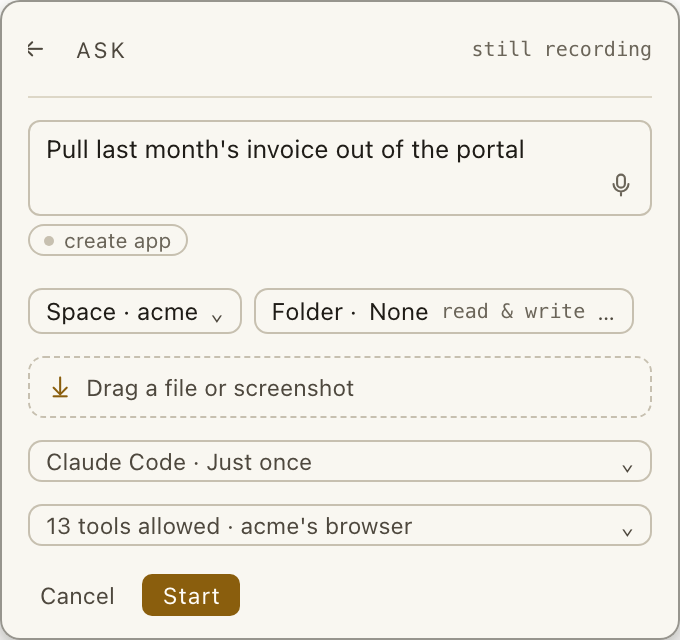
An ask carries the Space it was made in, for the whole of its life. A year later the row still says acme, so which browser did that is a question the card can answer rather than one you have to remember.

The tools you have switched on are named on the same line, and so is whose browser this is about to be. Nothing is granted by default, and nothing is granted to a Space you did not pick.

Nico's ask sheet: a typed question, a chip reading Space · acme, and a line reading 13 tools allowed · acme's browser. An ask on the card reading ‘Pull last month’s invoices out of the portal’, with a do badge and an acme badge beside it.
Before the press, and a month afterwards.
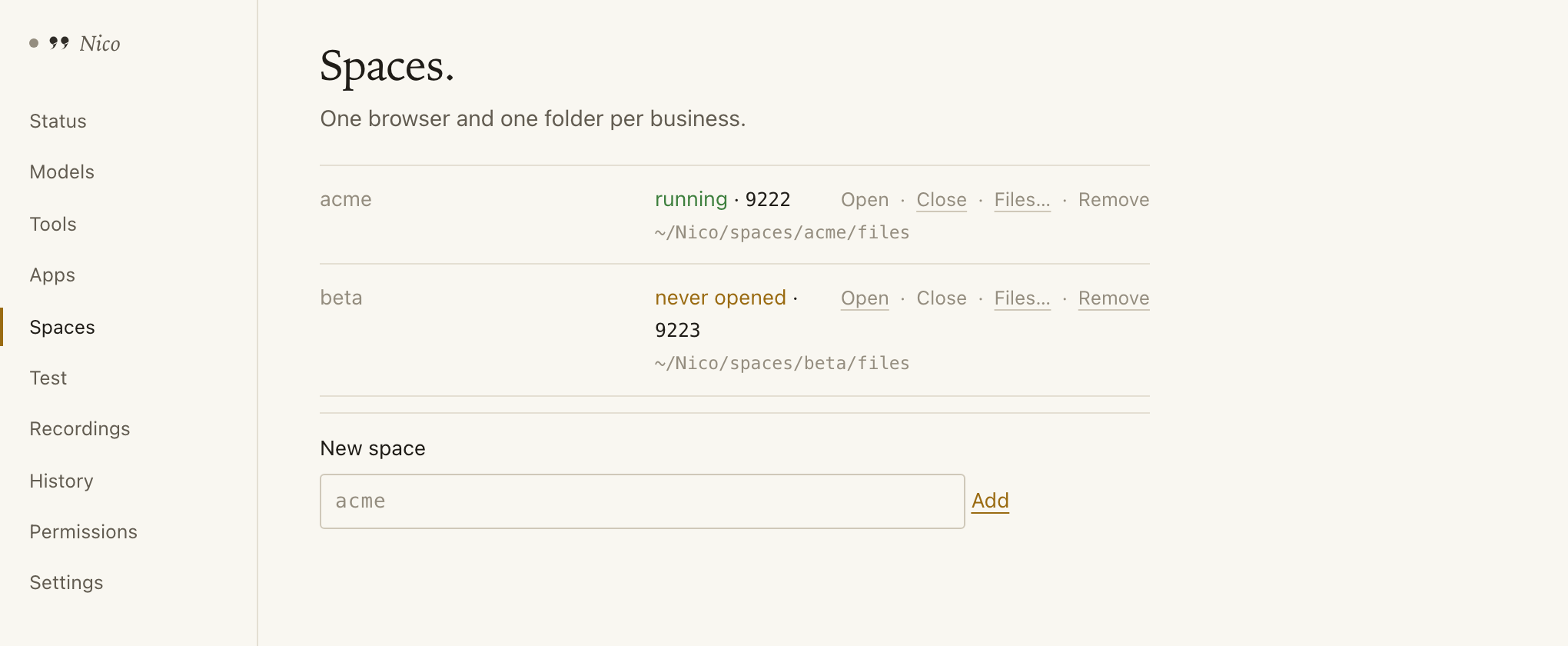
Nico's Spaces screen: acme running on port 9222 and beta never opened on 9223, each with its folder path and buttons for Open, Close, Files and Remove.
Two Spaces. One open, one never opened.

Spaces · the list

Start one, stop one, open its folder.

Making a Space is typing a name. It gets a Chrome of its own and a folder of its own, and the row tells you which of the five states it is in rather than a green dot that means four different things.

Closing one is a real close, not a kill — which is the difference between logging in once and logging in every morning.

Spaces · what Nico does in there

It drives that Chrome itself.

Not a plugin in your main browser, and not a browser in somebody’s cloud. Nico holds the connection to that Space’s Chrome: it reads the page, clicks, types, downloads into that Space’s folder, and reads and writes files there.

Nico never types a password, and never reads what is in a password box. Signing in is yours. The typing is refused in the code before the field is even focused, and the map Nico builds of a page carries what each control is — never what is in it. Measured against Chrome, on a filled password field, three ways of filling it.

One ask runs at a time, and a second waits its turn rather than fighting the first for the same window.

And what it does not fix: a page can carry instructions written at the model. Nico does not close that, and neither does anybody else.

our own engineering notes, doc 24 §2.2

Eight things people keep running.

None of these are ours. Each one was described in a sentence and built by the CLI you already pay for. Every one of them touches files you would never upload to a service.

localhost:8765 · burn
£4,180this month
−12%vs August
7.4 morunway
Contractors3,090
Hosting872
Software585
Apple / dev208

Burn chart from a bank CSV

Drop the export in. It categorises, charts, and keeps every month you have ever dropped.

Never leaves the Mac
localhost:5173 · receipts
Fly.io12 Sep£84.00
Anthropic09 Sep£160.00
Notion Labs04 Sep£38.40
Apple Developer02 Sep£79.00
Cloudflare01 Sep£20.00
37 PDFs read£1,204.60

A folder of receipts → a spreadsheet

Reads the PDFs your accountant asks for every quarter and writes one CSV.

Never leaves the Mac
localhost:7002 · library
Lex Fridman — Cursor team
Acquired — Nintendo, part II
Dwarkesh — scaling limits
Invest Like the Best — #402
Founders — Edwin Land

Podcast library, searchable

Paste a link. It pulls the transcript, summarises it, and keeps both, for good.

Never leaves the Mac
localhost:4410 · shots
Screenshot 2026-09-14 at 11.42.13.png
→ stripe-refund-dispute-flow.png
Screenshot 2026-09-14 at 14.08.55.png
→ postgres-slow-query-explain.png
Screenshot 2026-09-15 at 09.21.07.png
→ nico-hud-card-ask-sheet.png

Screenshots that name themselves

Looks at the picture, writes the filename you would have written, moves it.

Never leaves the Mac
localhost:3311 · applications
Ramp — offer
Linear — final round
Vercel — take-home sent
Figma — no reply, 21d
Stripe — rejected

A job search that tracks itself

Reads your own mailbox and keeps the board up to date. Nothing is forwarded anywhere.

Never leaves the Mac
localhost:6120 · photos
18,402scanned
1,336duplicates
9.2 GBrecoverable
IMG_4412.HEIC4 copies62 MB
IMG_2287.HEIC3 copies41 MB
Scan_0034.jpg2 copies18 MB

Duplicate finder for 18,000 photos

The one job you will never hand to a cloud service, because it is your entire camera roll.

Never leaves the Mac
localhost:8080 · decisions
› when did we decide to drop the mobile build?
 
14 Aug, #eng-planning. Priya proposed it after the
Android crash rate stayed above 2%. Confirmed
16 Aug in standup notes.
 
3 threads · 41 messages read

Ask your own Slack export

Four years of history, answerable, without granting anyone a workspace token.

Never leaves the Mac
localhost:9090 · digest
3 papers matched “speculative decoding”
competitor changed pricing page
2 repos you watch cut releases
nothing else worth waking you for

A morning digest of only your things

Runs before you get up. Reads what you told it to read. Sends nothing outward.

Never leaves the Mac

The cockpit

Two of them at once, on one card.

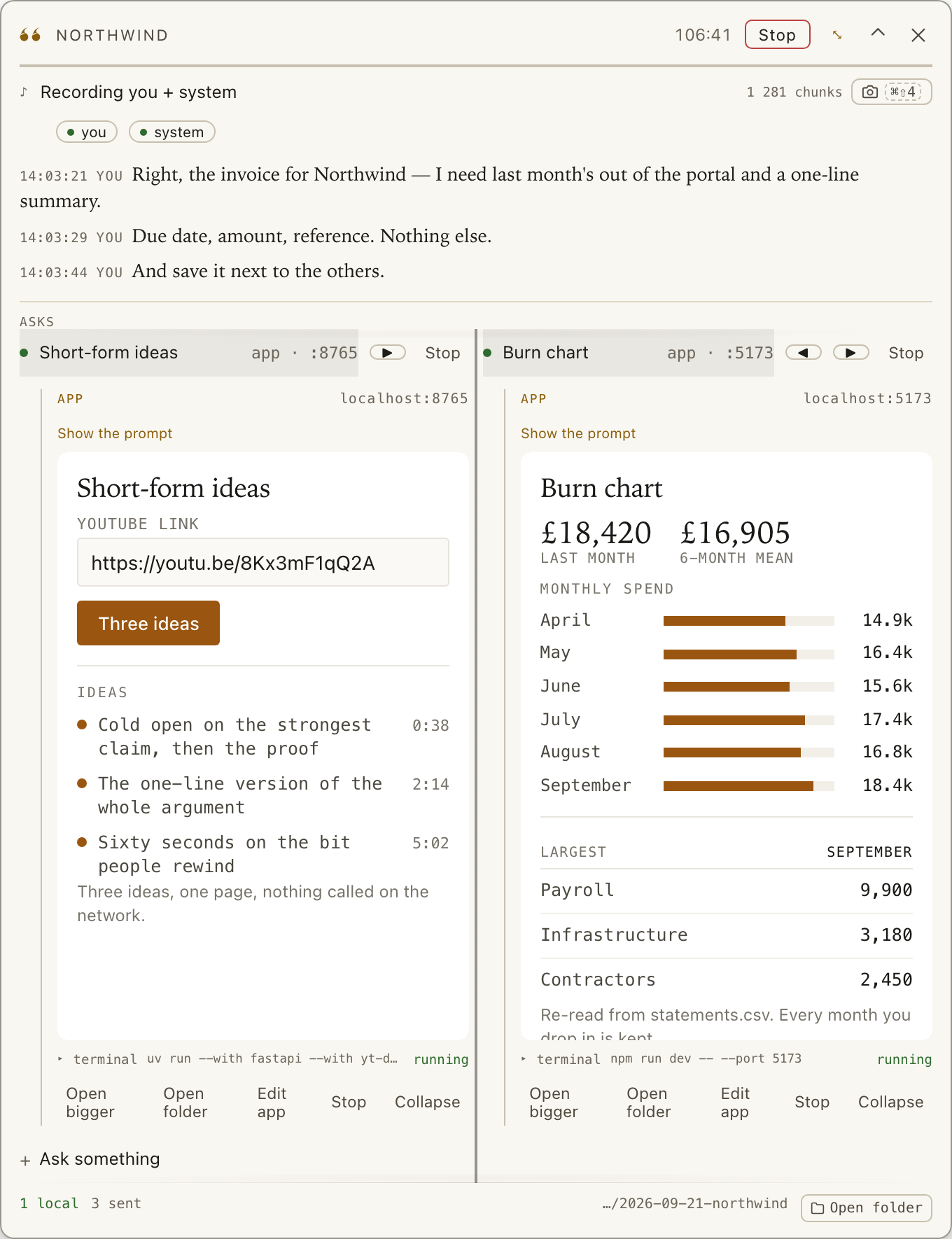
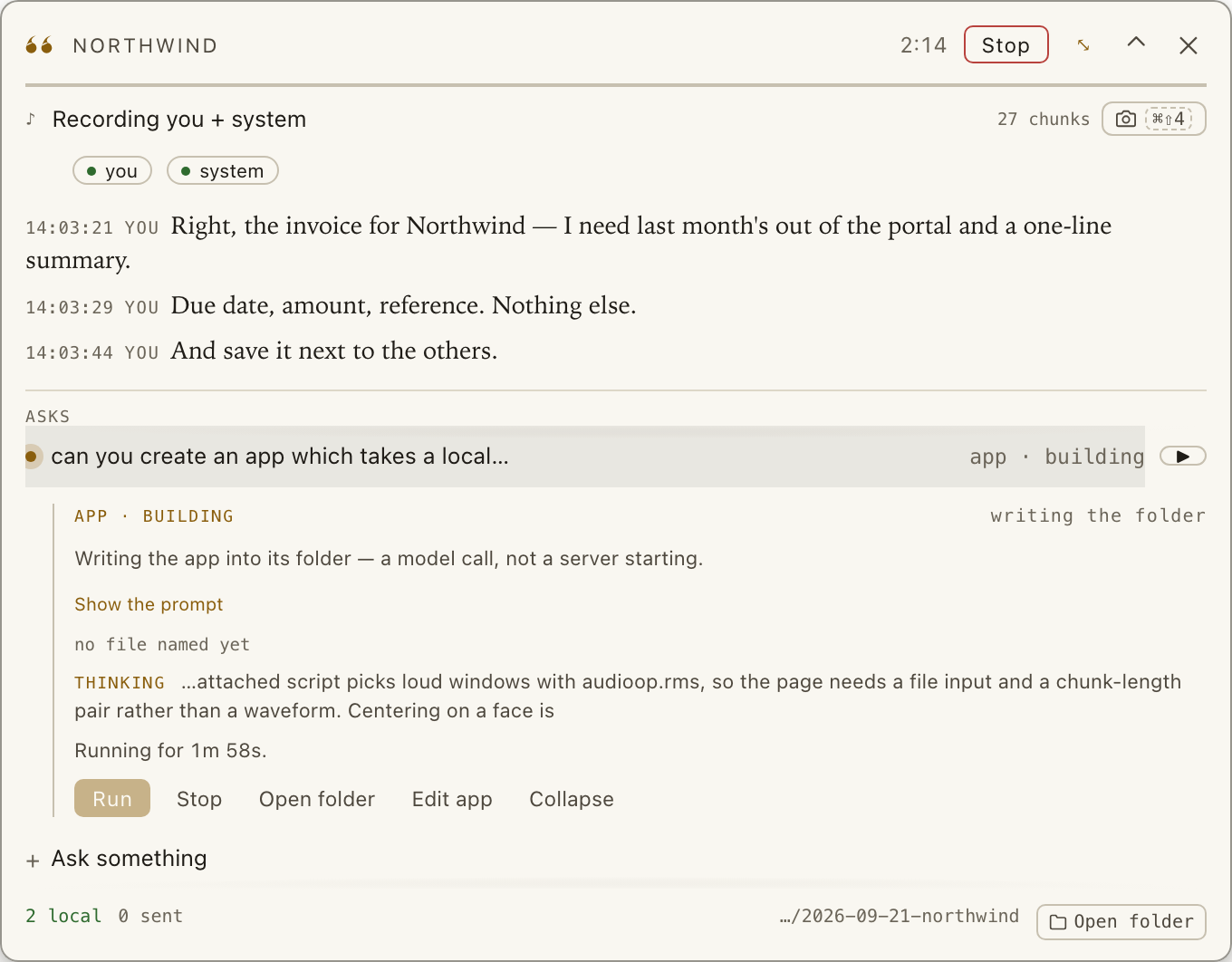
An app Nico wrote is a folder on your disk and a command that serves it. It shows in a pane on the card, so the tool and the thing you are doing are on the same screen — and two of them side by side when the job needs both.

Each has its own run line, its own Stop, and its own folder you can open in Finder. Nothing is deployed anywhere. No host to pay, no link to expire, no account to keep.

Ask again later and it is edited in place, with the last ten versions kept.

Two apps running side by side inside one Nico card: a short-form ideas tool on localhost:8765 and a burn chart on localhost:5173, each with its own run line, Stop and folder.
Two apps, both actually serving, on this Mac. Top of a longer card.

How it works

Describe it once. Keep it for as long as it is useful.

01

Ask for it in a sentence

Turn on create app and say what you want. Nico hands the job to the Claude Code or Codex you already have installed, on your own subscription. We charge you nothing for tokens because we never touch them.

02

It gets a home

One folder per app, outside any session. A data folder that survives every run, so what it collects accumulates instead of vanishing. Ten versions kept, so a bad edit is not a disaster.

03

Run it, change it, send it

Start it from a list, in a window of its own — or beside another app in the cockpit, when the job needs both at once. Edit it later by asking again. Export it as a zip — without your data folder — when somebody wants the tool but not your numbers.

Whose model

Ask again next week, with a different model.

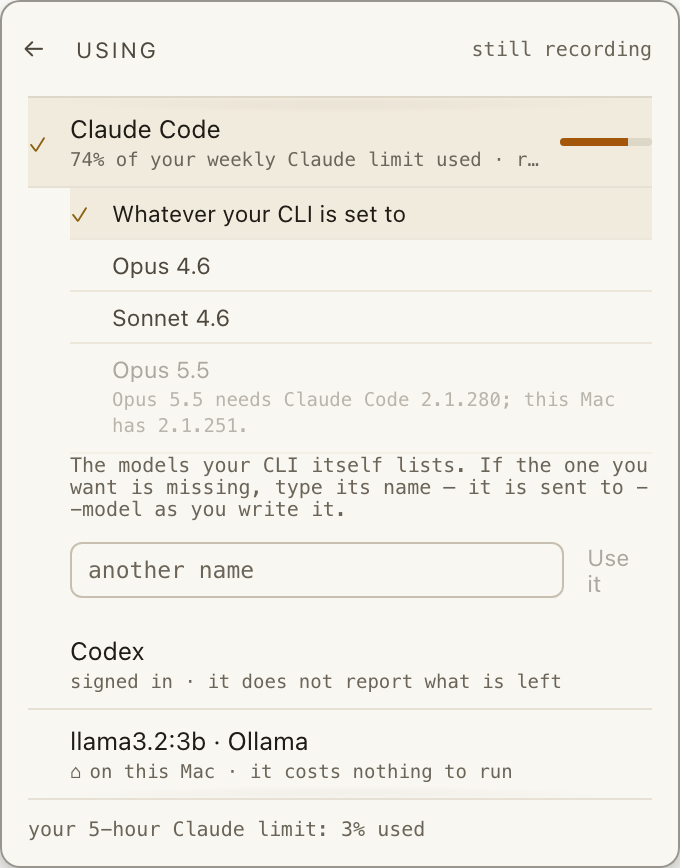
Every other tool in this category ships one model and that is the one you get. Here the model is a choice you make per ask: Claude Code, Codex, or a model running on your own Mac through Ollama — and the picker says what each one costs you before you pick, including how much of this week’s limit you have already spent.

We never touch a token. Prompts go to the CLI already on your Mac, on the subscription you already bought. There is no key to paste and nothing is proxied through us.

A local model costs nothing to run and is the one to reach for when the thing you are asking about should not leave the machine at all.

Nico's model picker: Claude Code showing 74% of the weekly limit used, Codex signed in, and llama3.2:3b on Ollama described as running on this Mac and costing nothing. A model on this Mac writing an app, the card showing the build in progress and the model's own working-out underneath it.
What each one costs, before you choose. And one of them working, on this Mac.
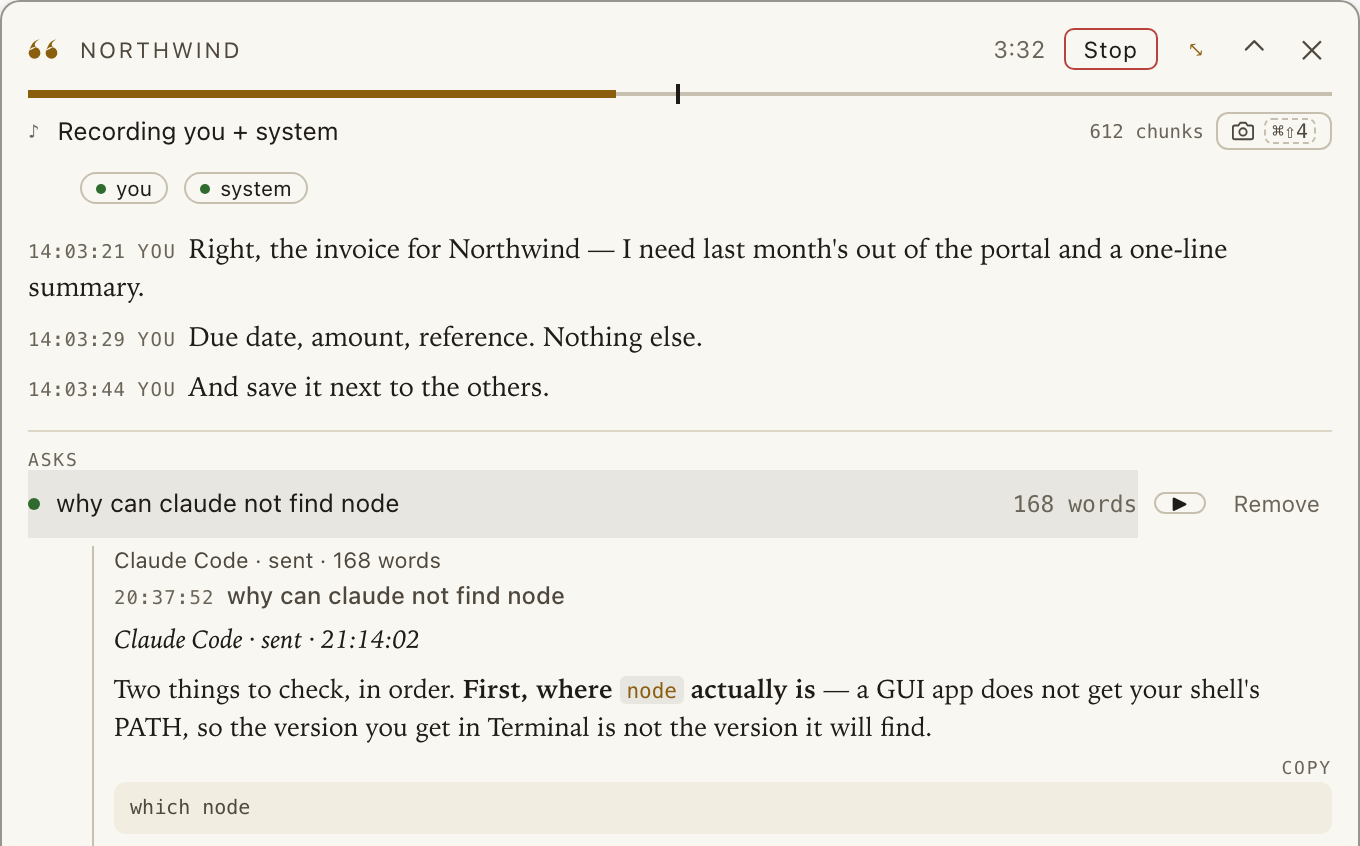
An answered ask opened on the card, headed Claude Code, sent, 168 words, with the answer and copyable code blocks beneath it.
The row says which model wrote this, and when.

What comes back

The answer is a file, and it stays one.

Each ask keeps its own question and its own answer on disk, in the session’s folder, in Markdown. Follow up on it and the earlier turns go with it, so the second question knows what the first one was.

Nothing is locked in a chat window that expires. If you stop paying us tomorrow, the folder is still there and still readable by anything.

Your data

The reason it can touch your bank statements.

Every app on this page works on files you would never hand to a SaaS: the camera roll, the mailbox, four years of Slack, the accounts. That is only reasonable because the whole thing runs where the files already are.

No accountThere is nothing to sign into, and nothing to sign out of.
No uploadNo request ever carries your files, your voice, or anything they produce.
Your browserA Space’s cookies and logins are a folder on this Mac. Nothing of a signed-in session is copied anywhere, and there is no browser of ours running in a data centre with your session in it.
Your keysAnything an app needs lives in the macOS Keychain, never in a file.
Your CLIPrompts go to the Claude Code or Codex on your Mac, under your own subscription and its own terms — in a terminal on the card, where it asks you before it changes anything.
OfflineTurn off the wifi and keep working — that is the test, and we would rather you ran it than believed us. Three things ever leave this Mac: a model download; a licence check, about once a month, carrying your key and a machine fingerprint; and an update check, once a day at most, carrying nothing at all. No files and no voice, ever. A transcript is the one thing that can leave, and only when you send it — an ask on Claude Code or Codex goes to them, through the tool on your Mac and on your own subscription; an ask on a model running here goes nowhere. Watch the lot in Little Snitch if you want to see for yourself.

Where it started

It began as a way to stop typing.

Hold a key anywhere on the Mac and talk. Whisper turns it into text on your own machine and the words land on the clipboard, ready to paste into the email, the commit message, the prompt. The project has been called talk, don’t type since the first day, and that is still the whole of it.

It is also how you ask for everything above. You say what you want the app to do. You do not sit down and write a specification for it.

Open a longer one and it keeps going: what you say and what your Mac is playing both become text, with timestamps, in a file in a folder — and the asks you hang off it work on that text. The transcribing happens on this machine, which is the only reason the next paragraph can be true.

⌃⌥D · hearing you

Build me something that reads the receipts folder every month and writes one spreadsheet my accountant can open

on the clipboard when you let go0:07

What it looks like while it works

Words on the left. What you asked for underneath.

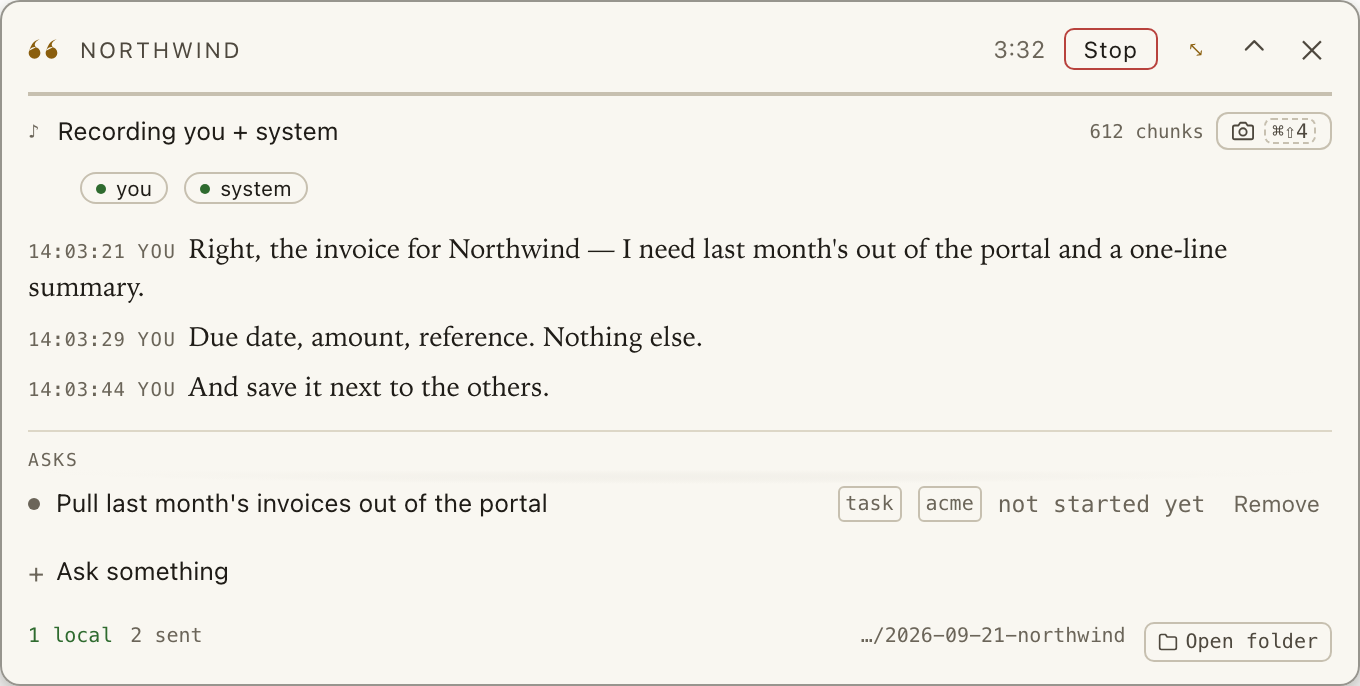
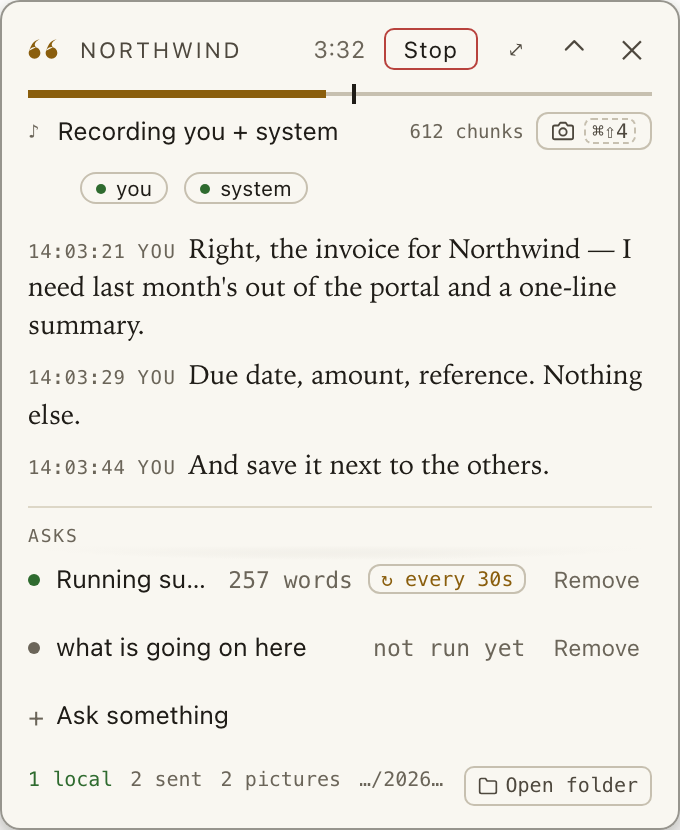
The card is the whole surface: what has been transcribed so far, and under it the things you have asked for, each with its own state. One is thinking. One has answered. One repeats itself every thirty seconds until you tell it to stop.

It is a panel over your work, not an application you switch to.

Nico's card: a running clock, the words you + system, a chunk count, timestamped text underneath, and two asks below that, one of them repeating every thirty seconds.
The card, mid-sentence.

Before you download it

What this does not do.

Everything above is on this page because it works. Here is the rest of it, in the same voice, so that nothing on the list arrives as a surprise a week in.

Price

Twenty-five dollars, and no tokens on our meter.

You are already paying $20, $100, maybe $200 a month for a coding agent. Nico does not resell it, mark it up, or proxy a single request through us. It runs the CLI sitting on your Mac, under the subscription you already bought.

What you are paying us for is the part nobody else builds: somewhere for those tools to live, a data folder that outlives the session, versions, exports, and an app that keeps working when the network is off.

Seven days, everything unlocked, no card asked for — and the clock starts the first time you actually use it, not at the download, so leaving it a fortnight costs you nothing. Build something on your own files and see whether you still want it running a week later. If you do not, you keep what it made and we never had your card number.
$25/ month, after 7 free days
  • Unlimited apps, kept and versioned
  • Unlimited dictation, on your Mac
  • Claude Code, Codex and Ollama
  • MCP tools, granted one at a time
  • macOS on Apple silicon
Download and start the trial

The trial needs no card. Cancel whenever. Your apps and their data are folders on your Mac — they stay yours either way.

If something goes wrong

Who you are actually buying this from.

Answers

The questions people arrive with — a lost licence key, a licence that says expired, the permission macOS will not offer twice — are answered on the support page. That page is on this website and loads nothing from anywhere else.

Longer write-ups are in the help centre, which is hosted elsewhere. Following that link takes you off this site; nothing of theirs loads here until you press it.

A bug, or something missing

vinay@wingmannico.com

One person reads that, and he replies. What you expected, what happened instead, and roughly when is plenty — there is no form and no ticket number.

Replying to your licence email reaches the same place and arrives with your purchase already attached.

The company

Pixmeknot Limited, registered in England and Wales, company number 08062851. Registered office: 65 Icona Point, Warton Road, London E15 2LE.

The terms, the privacy policy and the 14-day refund are on one page, and every outside party that could touch anything of yours is named in a table on it.